2026-09-18
Facial Wrinkle Lifting: How Many Ultherapy Lines Are Ideal? Comprehensive Guide to Mechanism and Results
Discover how Ultherapy works for facial wrinkle lifting, the real difference between 300 and 600 lines, and why anatomical depth and vector customization matter more than raw line counts alone. Learn how to prevent cheek hollowing and find your ideal plan with Dr. Sang-ah Yoon at Cheongdam Cellting Clinic in Seoul, Gangnam-gu, Korea. Explore real-time ultrasound visualization and personalized treatments for natural, long-lasting rejuvenation results today with our expert medical team and advance
Facial Wrinkle Lifting: How Many Ultherapy Lines Are Ideal? Comprehensive Guide to Mechanism and Results |
During Ultherapy consultations, one question is almost always asked first.
Is 300 lines enough? Do I need around 600 lines to see real results?
When considering facial wrinkle lifting, it is easy to assume that more lines naturally equate to a broader and more powerful treatment.
Because lines are expressed in clear numbers, they are also convenient to compare.

However, there is an essential factor you must examine before focusing purely on line count.
Ultherapy is not simply about accumulating lines; it requires strategically planning ultrasound energy based on target depth and anatomical location.
Appropriate energy placement tailored to individual facial contours is far more crucial than sheer numbers.
So, how many lines are right for your face?
To answer this, we must first look at how Ultherapy works beneath the surface of the skin.
How does Ultherapy actually tighten the skin?
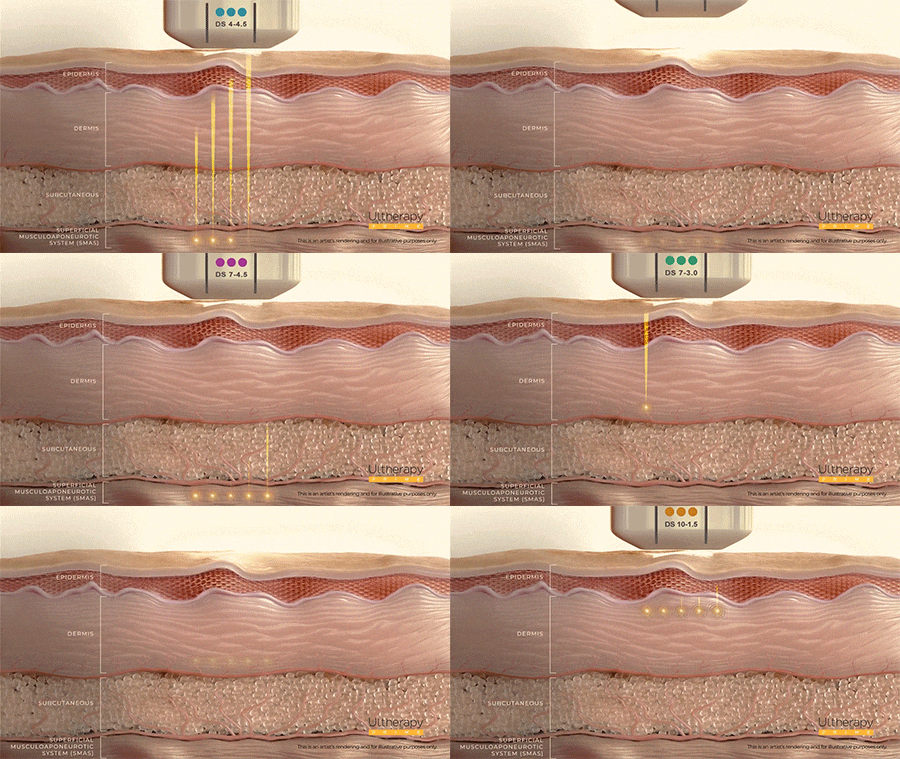
Ultherapy is a non-surgical lifting procedure that delivers focused ultrasound energy precisely to designated depths under the skin.
Instead of ablating the surface or making surgical incisions,
it focuses thermal energy directly onto targeted underlying tissues to induce a controlled thermal coagulation reaction.
Following this response, the tissue contracts and ongoing collagen remodeling begins.
Viewing facial wrinkle lifting merely as pulling the outer skin surface does not accurately capture how Ultherapy works inside.
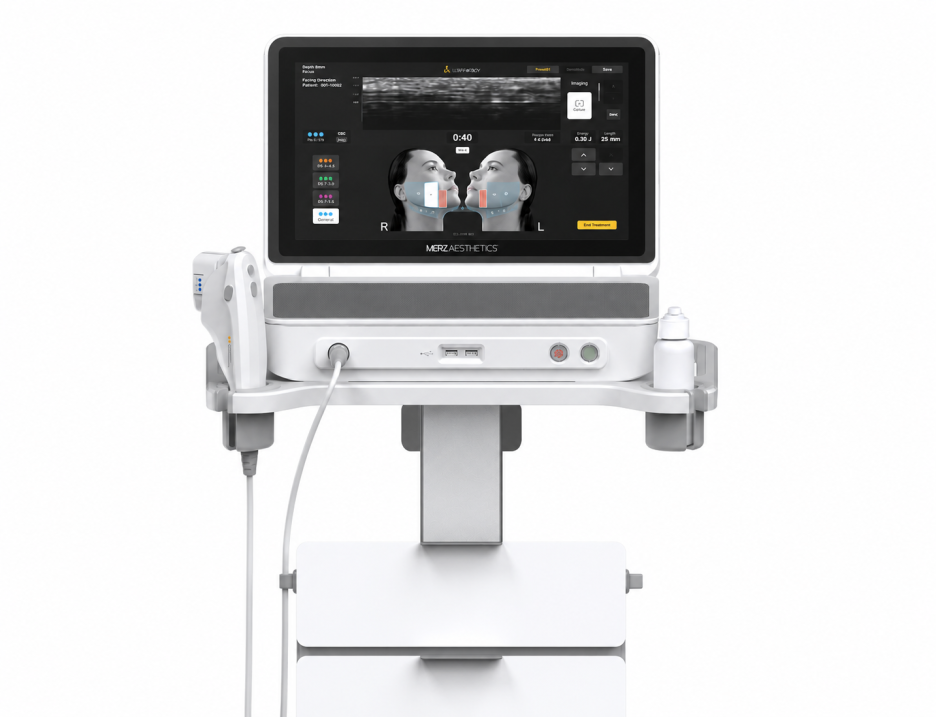
| Ultherapy typically utilizes transducers targeting depths of 1.5mm, 3.0mm, and 4.5mm. Because skin thickness, subcutaneous fat layers, and SMAS layer positions differ from person to person, transducers should never be used uniformly. Instead, treatment must be tailored to actual tissue structures. Real-time ultrasound visualization ensures that each pulse is applied with clear visibility of these anatomical layers. |
What, then, is the real difference between 300 lines and 600 lines?

Simply put, line count indicates the number of times ultrasound energy is delivered.
However, the number “300 lines” on its own does not reveal where, at what depth, or in which vector the energy was distributed.
Category | 300 Lines | 600 Lines |
Definition | Number of ultrasound energy pulses | Number of ultrasound energy pulses |
Coverage Area | Often planned for targeted focal zones | Suitable for broader, comprehensive coverage |
Key Consideration | Precise location, depth, and vector placement | Balanced distribution across wide treatment zones |
An ideal line count is not a fixed formula that exists in advance.
It should be the logical outcome determined after deciding exactly where treatment is needed.
Reversing this sequence can lead to distributing a pre-fixed quota across the face simply to exhaust the numbers, rather than analyzing what the face genuinely requires.
If you have less facial fat, should you reduce line counts?
When considering facial wrinkle lifting, many individuals worry about cheek hollowing or facial volume loss. Having less facial fat does not mean you are ineligible for Ultherapy, nor does it mean simply slashing the line count is the right answer. It is essential to distinguish between areas lacking volume and regions exhibiting true tissue laxity. A face with pre-existing volume loss must be approached completely differently from one where soft tissue heaviness is concentrated in the lower face.
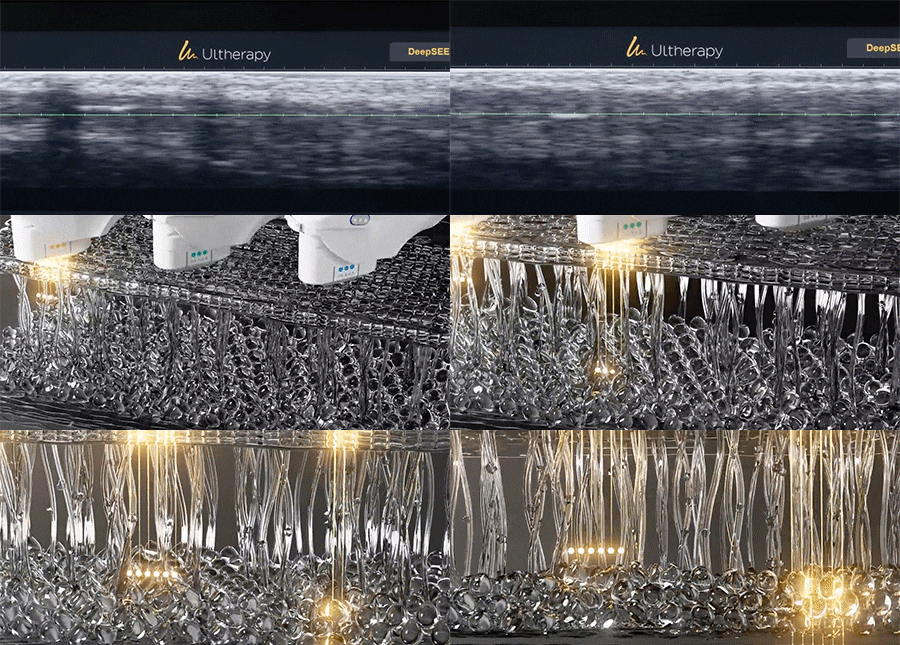
When planning facial wrinkle lifting, the face should never be treated as a single flat plane.
Unnecessary energy delivery to lean, hollowed zones should be avoided, while pinpointing areas suffering from true loss of elasticity.
Treatment scope and vector direction must take into account underlying anatomical structures, including facial nerves and vasculature.
The goal is not to deliver high numbers, but to deliver the precise energy required directly to the tissues that need it.
Line Count is Determined Only After Facial Evaluation


It is natural to focus on numbers like 300 lines or 600 lines when researching facial wrinkle lifting.
However, Ultherapy’s clinical suitability cannot be defined by numerical figures alone.
Skin and fat thickness,
the vectors of sagging,
areas with localized volume loss,
and the specific anatomical tissue depths to target
must all be thoroughly identified first.
Only after this in-depth assessment should the treatment areas, target depths, and required lines be finalized.
In facial wrinkle lifting, the fundamental question extends far beyond how many lines to receive.
While line counts are easily measured and compared, individual facial anatomy is complex.
Ultherapy should always be tailored with this same nuanced perspective in mind.
Thank you. This has been Dr. Sang-ah Yoon, Medical Director.
Inquiries |


























Frequently Asked Questions
How does Ultherapy lifting work?
It delivers focused ultrasound energy to targeted depths beneath the skin to induce a controlled thermal reaction. Without incising the skin surface, it non-invasively contracts tissue and stimulates ongoing collagen remodeling, creating a natural lifting effect.
What is the difference between Ultherapy 300 lines and 600 lines?
The primary differences lie in the number of energy pulses and treatment coverage. 300 lines are typically customized for focal trouble areas, whereas 600 lines provide broader coverage. However, the exact depth and vector placement of the energy matter more than just the number of pulses.
Should Ultherapy line counts always be reduced if you have less facial fat?
No. Rather than simply reducing line counts, it is essential to distinguish between areas of volume deficiency and actual tissue laxity. Avoiding unnecessary energy delivery to lean zones while treating lax tissues at the right depths helps prevent unwanted hollows.
How is the ideal Ultherapy line count determined for each person?
Line count is decided based on a comprehensive anatomical analysis of the face. Factors such as skin and fat thickness, sagging vectors, and volume distribution are evaluated using real-time ultrasound imaging before the target depth, coverage area, and final line count are planned.